What least-cost formulation does
Every formula is a set of limits: at least so much crude protein, no more than so much fiber, calcium and phosphorus inside a band, one ingredient capped at a share of the batch. Least-cost ration formulation is the arithmetic of meeting all of those limits at once at the lowest ingredient cost per ton. By trial and error that takes an afternoon for one formula. A solver does it in a second and gets the same answer every time.
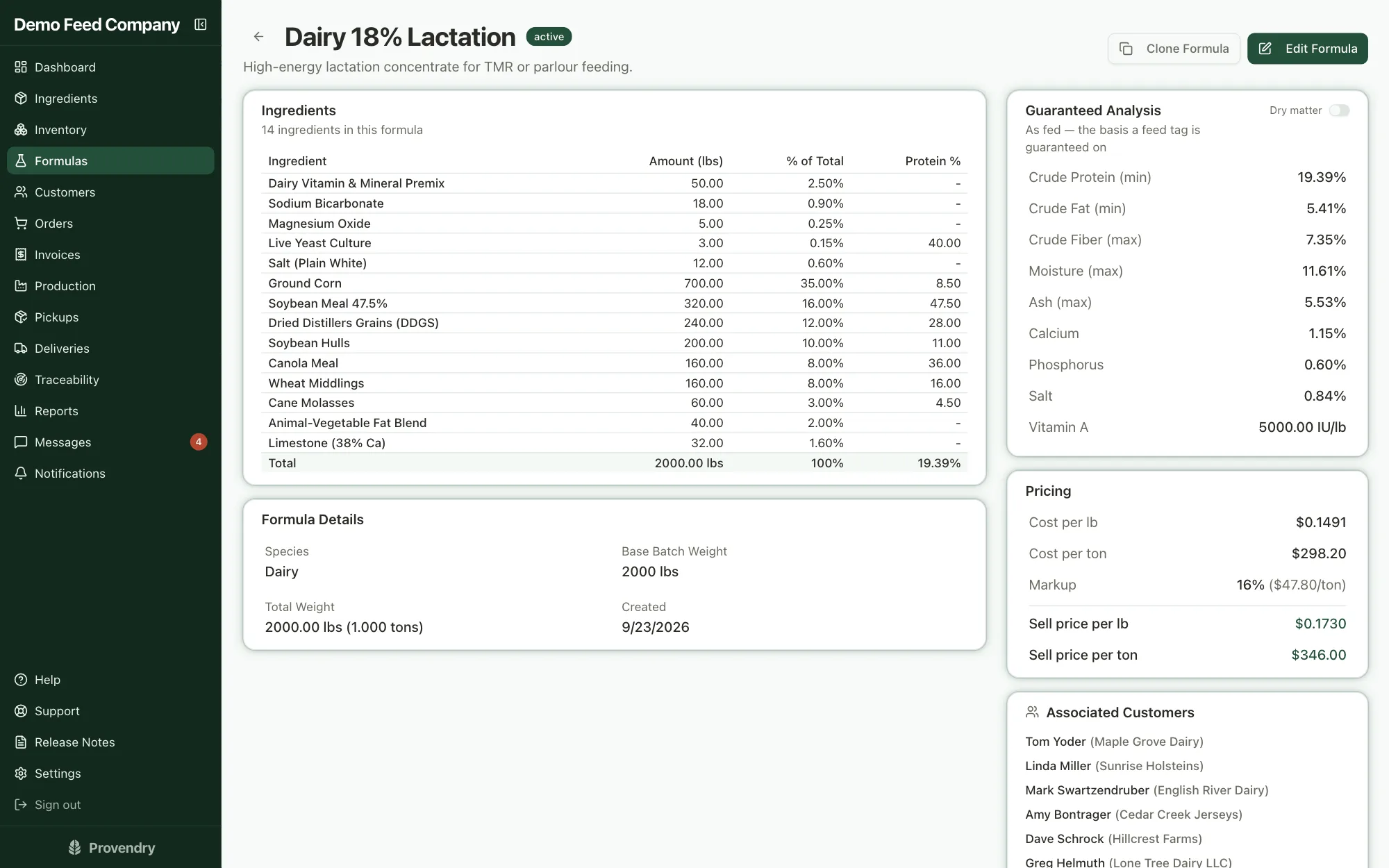
In Provendry you build the formula from your own ingredient catalog, with your own nutrient values and your current costs. Set the nutrient targets, lock any ingredient you don't want moved, give others a minimum and maximum, and press Calculate. The guaranteed analysis and the cost per ton update as you go, so you see what the answer does to the feed and to the price before you save it.
Why least-cost feed formulation in Excel stops working
Plenty of mills start in a spreadsheet, and Excel's Solver will find a cheapest mix. The trouble comes later, once there are dozens of formulas and prices that move every week:
- It solves one formula at a time. When soybean meal moves, every formula that uses it has to be opened and re-run by hand.
- Ingredient prices live in cells somebody has to remember to update, so the sheet goes quietly out of date.
- There's no history. When a customer asks what changed in their feed since spring, nobody can say for sure.
- The answer stops at the sheet. The order, the work order, the tag and the invoice are all typed again somewhere else, and any of them can drift.
Provendry keeps every ingredient price in one place, keeps every version of every formula, and carries the formula straight through to the mixer and the customer.
Two ways to solve: Cheapest Mix or Keep My Ratios
Least-cost alone can change a formula more than you'd like. Swap enough of one ingredient for a cheaper one and the feed meets spec on paper but no longer looks, smells or feeds like what your customers have been buying. So the solver has two modes:
- Cheapest Mix finds the lowest-cost mix that hits every limit you set.
- Keep My Ratios starts from the formula you built and nudges it just enough to hit the spec, so the feed stays recognizable.
Use whichever fits the formula. A commodity blend can chase price; a customer's long-standing dairy ration probably shouldn't.
See which limit is driving the price
After a least-cost solve, Provendry shows which limits are holding the price up and what relaxing each one would save per ton. If a tenth of a point of protein is costing real money on every ton, you see it in plain numbers and can decide whether that guarantee is worth it.
It also shows which ingredients the cost rests on, and what every cent they move is worth per ton, so you know which supplier quote deserves the phone call.
When ingredient prices move
Change an ingredient's cost once and every formula that uses it reprices. Receive a delivery at a new price and the ingredient's cost re-averages itself, and every change is logged: who changed it, when, and which formulas it moved.
When prices move, Provendry can also show which formulas could be made cheaper at today's prices. Premixes and medications are left alone, so nobody's vitamin pack or medicated formula gets quietly re-solved.
Sell price and margin beside the formula
A cheaper formula only matters if you know what it sells for. The sell price is set on the same screen as the formula, as a markup percentage or a fixed amount per ton or per pound, with the margin shown beside it.
- Volume prices at different load sizes, and fixed sack or tote prices
- Any price that would sell below cost is flagged red
- A printable price sheet of every formula's standard, volume and package prices
- Profit and margin reports for every formula and customer, from what each load actually cost to make
From formula to order, tag and invoice
The formula you solve is the one the order uses, the one the work order prints for the mixer, and the one the feed tag is built from, so the tag always says what's in the bag. Delivered loads roll onto invoices and sync to QuickBooks Online; that side is on the feed mill invoicing page.
Every save keeps a version with the changes laid side by side, and any two formulas can be compared nutrient by nutrient and ingredient by ingredient. Canadian mills work in kilograms and tonnes with prices in Canadian dollars; US mills work in pounds and tons.
Comparing options? See our honest comparison of feed formulation software.
Questions mills ask
- What is least-cost feed formulation?
- It's finding the cheapest combination of your ingredients that meets every nutrient minimum and maximum a formula has to hit. Provendry's solver works from your own ingredient catalog and current costs, and shows the guaranteed analysis and cost per ton of the answer before you save it.
- Can I lock an ingredient or give it a minimum and maximum?
- Yes. Lock an ingredient's amount so the solver can't move it, or give any ingredient a minimum and maximum. When prices move and Provendry looks for formulas that could be made cheaper, premixes and medications are left out.
- How is this different from least-cost formulation in Excel?
- Excel's Solver finds the cheapest mix for the sheet in front of it. Provendry keeps every ingredient price current in one place, reprices every formula when a cost changes, keeps a version history of every formula, and carries the formula onto the order, the work order, the feed tag and the invoice.
- Does it work in kilograms and tonnes?
- Yes. A Canadian mill works in kilograms and tonnes, with prices per tonne in Canadian dollars; a US mill works in pounds and tons. The whole account follows the country you sign up with, nutrient units included.
- Can I see what changed between versions of a formula?
- Yes. Every save keeps a version, and any two can be laid side by side with the changes marked. You can also compare any two different formulas nutrient by nutrient and ingredient by ingredient.
- What does least-cost formulation software cost?
- Provendry is $199 USD a month, or $269 CAD for a Canadian mill, with every feature included and no charge per user. The trial is 7 days with no card to start, and it opens with a sample mill full of formulas to try the solver on.